
Views: 320 Author: SEPPE Garnet Team Publish Time: 2026-07-31 Origin: SGA Blasting
Conductivity values often appear on a garnet technical data sheet or certificate of analysis. The number is useful, but it is easy to misread. The test does not measure how conductive dry garnet is during blasting. It measures the conductivity of a water extract prepared from the abrasive.
This result helps assess water-soluble ionic contamination. It should be reviewed with the test method, reporting units and the acceptance limit stated for the project.
Water-soluble salts carried by an abrasive can be transferred to freshly blasted steel. If they remain beneath a coating, they may contribute to blistering or premature corrosion. Conductivity testing provides a practical way to screen an abrasive for soluble ionic contamination before the material is accepted for use.
The result does not confirm coating suitability on its own. It helps buyers and inspectors identify lots that need closer review. It also provides a consistent basis for comparison when samples are tested by the same method.
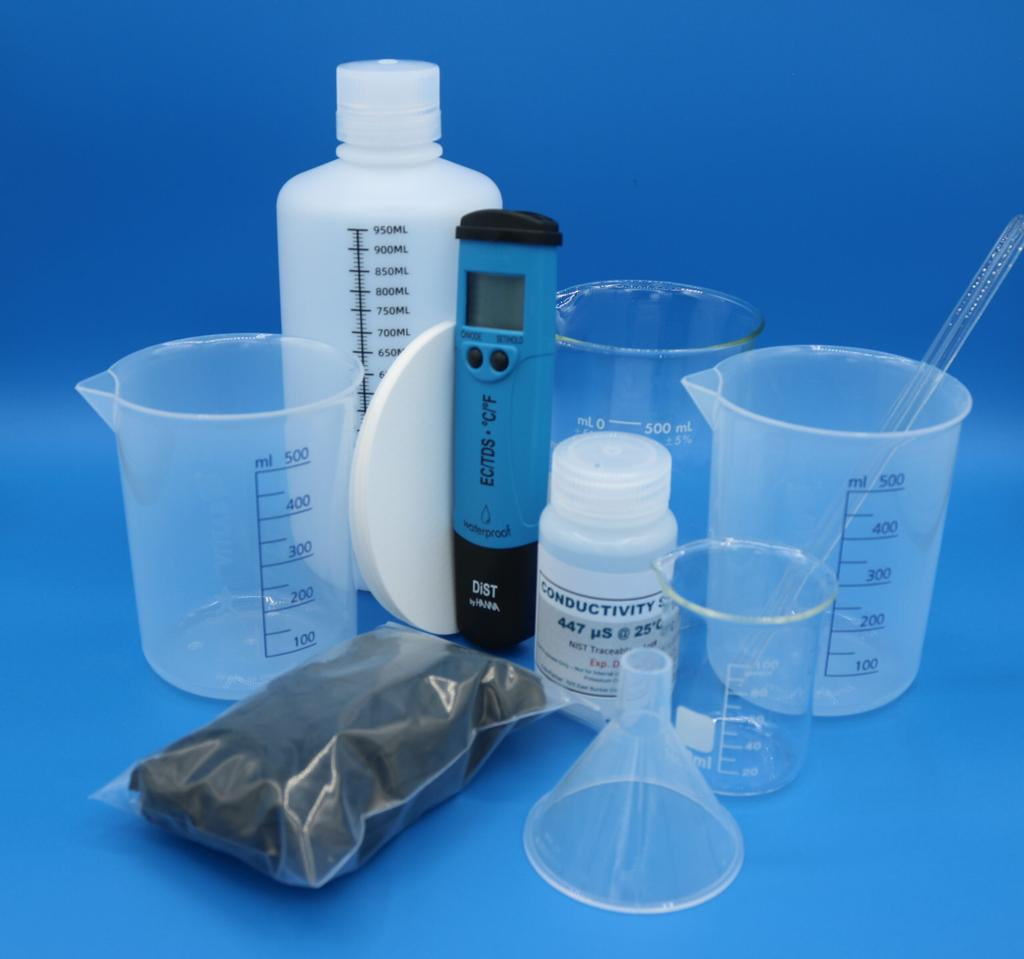
Conductivity reflects the combined response of water-soluble conductive species. It does not state the chloride concentration or identify any other individual ion. Water-soluble chloride requires a separate test.
Units must also be checked before comparing reports: 25 mS/m is equal to 250 µS/cm.
ASTM D4940 uses equal volumes of abrasive and pure water. The practical procedure is:
Measure 300 ml of garnet into a 600 ml beaker, then add 300 ml of pure or deionized water.
Stir for 1 minute. Allow the mixture to stand for 8 minutes, then stir for another 1 minute.
Filter enough liquid for measurement and discard the first 10 ml of filtrate.
Rinse the calibrated conductivity cell with low-conductivity water, then with the sample solution. Measure successive portions until the reading is stable and report the result in the required units.
The conductivity meter and cell constant must be checked according to the instrument instructions. ASTM D4940 does not require the test result to be below 150 µS/cm. It provides the measurement procedure; the acceptance limit comes from the applicable abrasive or project specification.
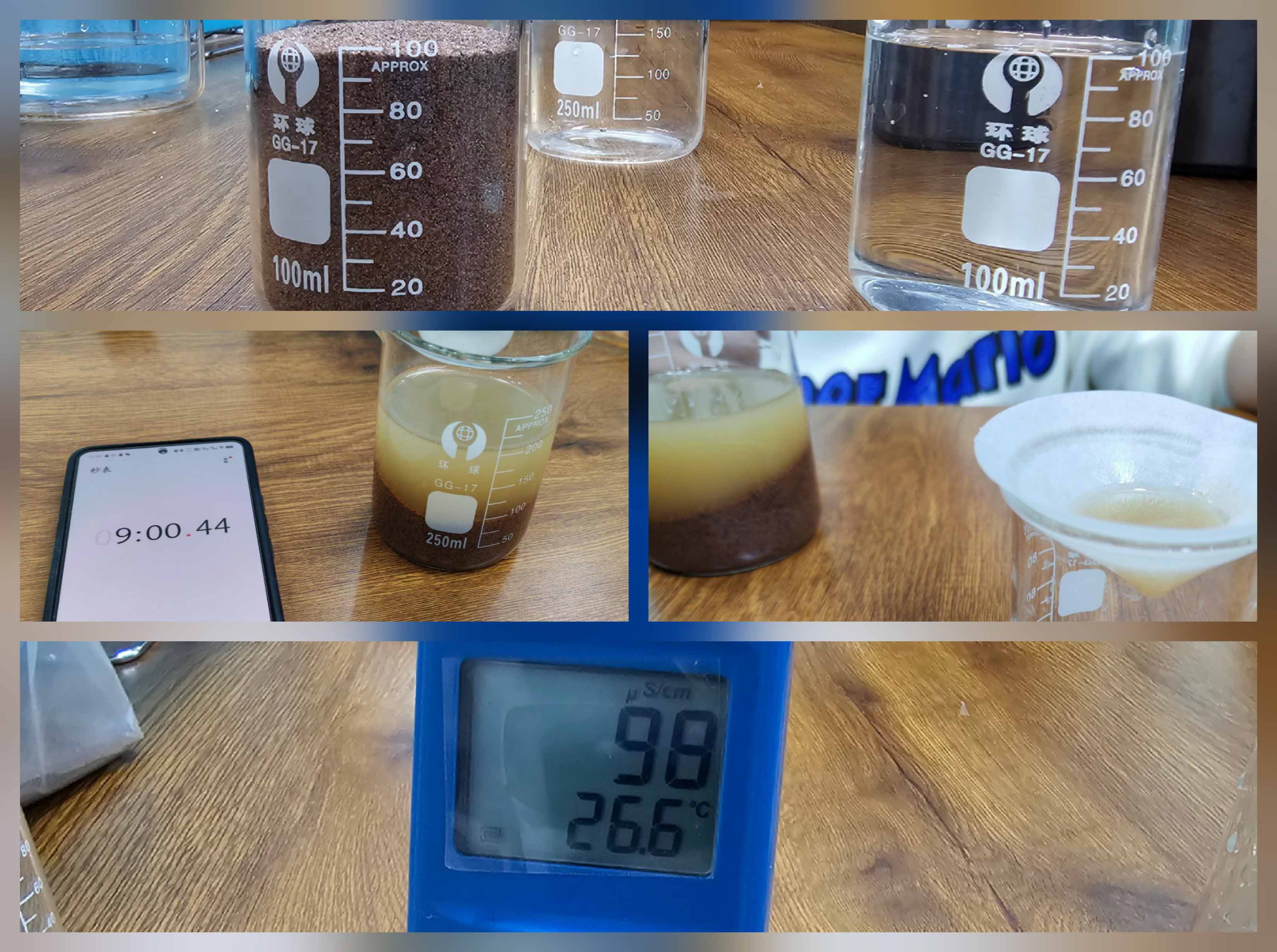
SEPPE garnet conductivity test record showing the mixing, settling, filtration and measurement stages.
ISO 11127-6:2022 uses a mass-to-volume extraction and requires duplicate tests. Each test uses 100 g of abrasive and 100 ml of conductivity water. The mixture is shaken for 5 minutes, left to stand for 1 hour, shaken again for 5 minutes and allowed to settle. It is filtered if the liquid does not clear.
The liquid is measured at 20 °C and reported in µS/cm. If the duplicate results differ by more than 10% relative to the higher result, the test is repeated. The mean of two valid results is reported to the nearest 10 µS/cm. Because the ASTM and ISO extraction procedures differ, their results should not be treated as interchangeable without confirming the method used.
| Reference | Limit | Meaning |
|---|---|---|
| ISO 11126-10:2025 | Maximum 25 mS/m | Product requirement for almandite garnet supplied in a new, unused condition, tested according to ISO 11127-6. |
| ASTM D4940-25 | No universal limit | The standard defines a test method. The project or purchasing specification sets the acceptance value. |
| Project requirement | Sometimes maximum 150 µS/cm | A strict contractual limit used by some buyers. Not a universal ASTM D4940 or ISO 11126-10 maximum. |
Therefore, new almandite garnet tested for conformity with ISO 11126-10:2025 must not exceed 25 mS/m, equivalent to 250 µS/cm. A 150 µS/cm limit applies only when the purchase order or project specification requires that stricter value.
A low conductivity result does not prove that an abrasive is dust-free or ready for every coating project. It does not replace checks for moisture, particle-size distribution or water-soluble chloride. It also does not measure waterjet feeding stability.
For purchasing, define the method and acceptance limit before comparing suppliers. If a project needs lot-specific conductivity or chloride data, request the relevant batch COA from SEPPE.
