
Views: 165 Author: SEPPE Garnet Team Publish Time: 2026-07-31 Origin: SGA Blasting
River, beach and rock garnet are source descriptions, not fixed performance grades. The distinction matters. A well-processed rock garnet can be cleaner and more consistent than a poorly screened alluvial product, while river garnet may suit a different blasting job better.
Source helps explain how the grains were formed. It does not decide blasting speed, dust level or surface profile on its own.
River garnet comes from inland alluvial deposits. Weathering and river transport tend to soften sharp edges, so the processed grains are often subangular. The recovered material still has to be separated, washed and screened before it becomes an industrial abrasive.
Beach garnet, sometimes called sea garnet, is recovered from coastal placer deposits. Contact with a marine environment does not prove that the finished abrasive has excessive chloride. Effective washing can remove soluble contamination, but the finished batch must be tested.
Rock garnet is mined from a hard-rock deposit and mechanically crushed. This usually produces more angular grains. Crushing can also generate fines, making separation and final screening important.
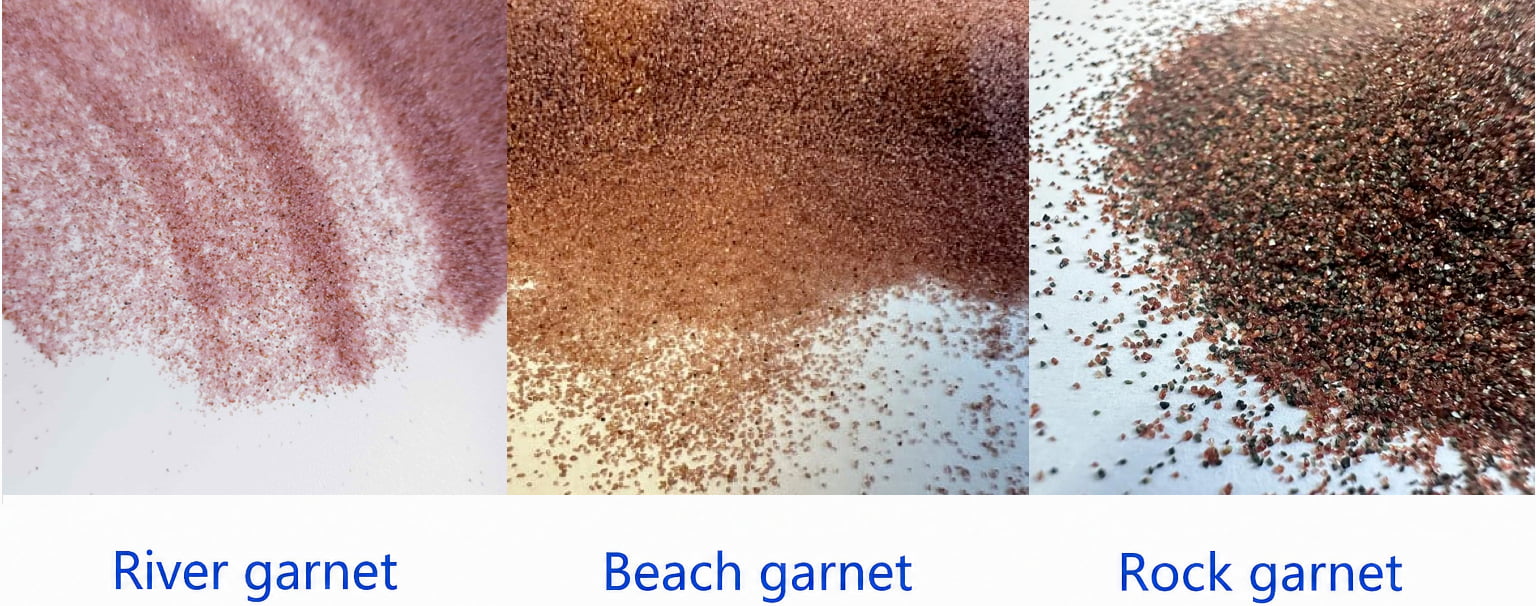
Illustrative comparison of River, Beach and Rock Garnet.
| Source | Common grain character | Point to verify |
|---|---|---|
| River garnet | Often subangular after natural transport and processing | Removal of sediment and control of the final size range |
| Beach garnet | Rounded to subangular, depending on the deposit and processing | Washing quality and soluble contamination in the supplied batch |
| Rock garnet | Usually more angular after crushing | Fines and oversize particles remaining after processing |
A blasting abrasive must remove the specified contamination and leave a suitable surface profile. More angular grains may cut aggressively, but that is not always the desired result. Thin steel, a light coating or a restricted profile can require a less aggressive grade.
Start with the sieve analysis for the supplied grade rather than relying on a general mesh label. Excess fines can reduce visibility and add cleanup work. Oversize grains may produce a rougher profile than the coating system allows.
For coated steel, moisture and soluble contamination also matter. Conductivity and water-soluble chloride are separate results, so one cannot replace the other. A coastal source should not be rejected without test data, and an inland source should not be accepted without it.
Rock garnet can be a candidate when a sharp cutting action is useful. Processed river garnet may provide a different balance of cutting action and durability. Beach garnet can also perform well when washing and grading are properly controlled.
No source wins every comparison. The useful test is whether a representative batch reaches the required cleanliness and profile under the project’s pressure, nozzle and recovery conditions. That result is more informative than the deposit name.
SEPPE supplies both mined rock garnet and processed alluvial river garnet.Contact our technical team to request detailed test data, batch COA reports, or sample comparisons for your specific blasting or cutting job.
