
Views: 360 Author: SEPPE Garnet Team Publish Time: 2026-07-24 Origin: SGA Blasting
Do you know sandblasting and shot blasting? Both prepare surfaces by blasting abrasive at high speed.
Terminology used here: “sandblasting” means compressed-air abrasive blasting through a nozzle, even when the abrasive is garnet rather than sand. “Shot blasting” means centrifugal wheel blasting in an enclosed machine. Some industries use these terms more broadly, so the equipment type should always be confirmed.
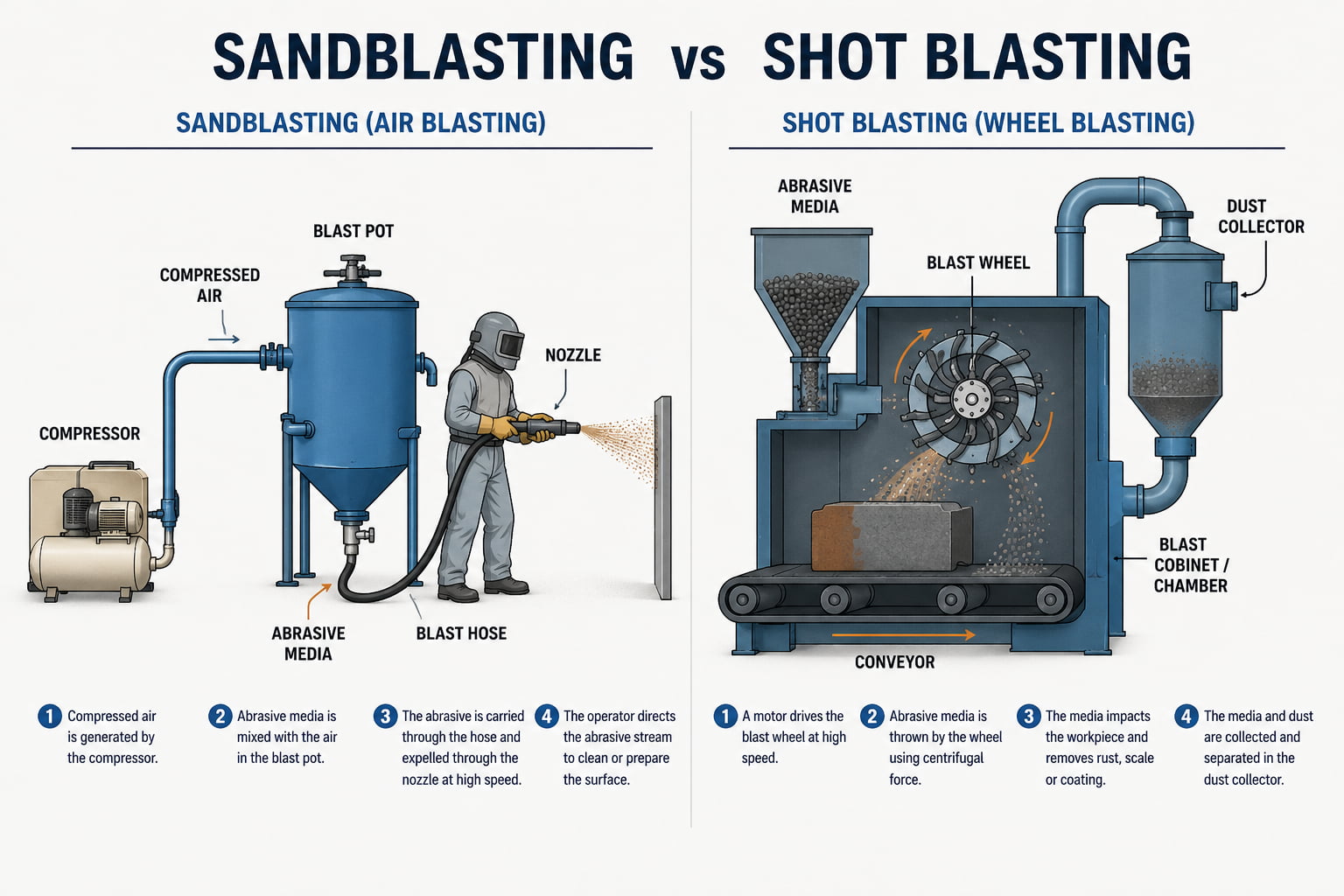
In air blasting, compressed air carries the abrasive through a hose and nozzle. The operator or automated nozzle directs the stream, making it possible to work around corners, inside vessels and across structures that cannot be moved into a machine.
A wheel-blast machine uses fast rotating blades to throw abrasive at the workpiece. Parts pass through an enclosed cabinet on a conveyor, hanger, table or tumble system. Once the machine is set up for a part, it can provide consistent coverage at a high production rate.
| Comparison | Compressed-air sandblasting | Centrifugal shot blasting |
|---|---|---|
| Abrasive propulsion | Compressed air through a nozzle | Centrifugal force from rotating blast wheels |
| Common media | Garnet and other metallic or non-metallic abrasives | Steel shot or steel grit is common; media must match the machine |
| Work location | Portable or installed in a blast room | Normally fixed and enclosed |
| Typical work | Large structures, complex shapes and on-site maintenance | Repeatable batches of parts that can enter the machine |
| Process control | Nozzle path, pressure, distance and abrasive grade | Wheel speed, media flow, part movement and blast coverage |
| Abrasive recovery | Expendable or recovered, depending on the installation | Usually integrated into the machine for continuous recycling |
Garnet is commonly used in compressed-air blasting. Its angular grains cut rust and old coating while creating a surface profile for repainting. A coarser grade such as SGA 20/40 is a practical starting point for heavier removal, while SGA 30/60 offers more control for general coating preparation.
Garnet’s non-metallic nature also avoids ferrous media contamination in sensitive scenarios. Note this benefit comes only from the abrasive itself—hoses, blast pots and recovery units must still be kept clean to prevent cross-contamination. Do not use garnet in centrifugal wheel-blast machines unless the equipment manufacturer explicitly approves it for your specific working conditions.
Large, in-place structures (bridge sections, storage tanks, installed pipework) suit air blasting, as the nozzle can reach any accessible surface. Wheel blasting is preferred for high-volume batches of castings or fabricated parts, thanks to its consistent, repeatable coverage in an enclosed system.

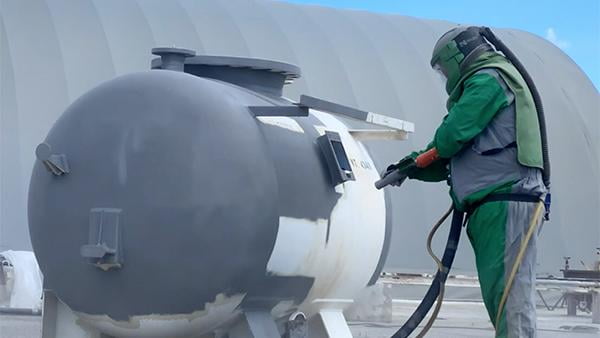
Geometry is as important as production volume. Nozzles easily reach recesses and internal areas that fixed blast wheels struggle to target uniformly. Simple parts compatible with conveyor or tumble systems, meanwhile, gain little from manual blasting’s flexibility.
There is no universal better option. Choose based on whether the method can consistently reach the surface, use approved abrasives, and meet your required finish.
