
Views: 0 Author: SEPPE Garnet Team Publish Time: 2026-10-22 Origin: SGA Blasting
Garnet is a group of natural silicate minerals. Due to its hardness, wear resistance, and particle characteristics—which are well-suited for specific industrial processes—it is widely used as an abrasive and a filtration medium.
While industrial demand for garnet exists globally, its mineral resources are unevenly distributed; consequently, many countries must rely on imports to meet their industrial needs.
China, India, and Australia are major global producers of industrial garnet, each possessing abundant garnet resources.
A 2006 publication by the United States Geological Survey (USGS) reported that U.S. industrial garnet imports came mainly from India, China, and Australia. However, there are significant differences in the types of deposits and processing capabilities across these three regions, resulting in distinct performance characteristics for the garnet abrasives they produce.
Coastal sand deposits are an important source of industrial garnet in India. The deposit at Navaladi–Periathalai, in the southern part of Tamil Nadu, is one of the most representative garnet-rich coastal sand deposits. Other notable sites include the large-scale, multi-mineral heavy mineral sand deposit at Chhatrapur in the Ganjam district of Odisha, and the multi-mineral coastal sand deposit at Srikurmam–Srikakulam in Andhra Pradesh.
Wave action, longshore currents, and sediment transport processes lead to the enrichment of heavy minerals. The raw sand may also contain associated minerals such as ilmenite, rutile, zircon, and sillimanite.
(AMD mineral sands information; AMD overview of heavy mineral sand deposits in India)

Australia hosts several garnet resources, including those at Port Gregory, Lucky Bay, and Harts Range. One of the most significant production areas for industrial garnet is located at Port Gregory in Western Australia. Geoscience Australia describes Port Gregory as a garnet deposit located within mineralized sand dunes.
Over long periods, the garnet here has undergone weathering and sedimentation, forming industrially significant enriched layers within the dunes. Producers subsequently process the extracted sand—via wet separation, drying, magnetic separation, and screening—into abrasives of various grain sizes.

In the Chinese market, both alluvial garnet and crushed-rock garnet are available. An example of alluvial garnet is SEPPE SGA garnet, sourced from mining areas in northern China.
Producers extract this type of raw material from deposits found in valleys, riverbeds, or alluvial plains. It undergoes a series of processes—including sorting, washing, magnetic separation, drying, and screening—to produce the specific grain sizes required for waterjet cutting and sandblasting applications.

Read the related article: Distinguishing Between River, Beach, and Rock Garnet.
| Parameter | China SEPPE SGA Garnet 30/60 | India | Australia |
|---|---|---|---|
| Primary Type | Alluvial pink garnet | Coastal placer garnet | Dune-hosted heavy mineral sand |
| Garnet Content | 98% | 98.70% | >97% |
| Main Mineral | Almandine | Almandine | Almandine |
| Mohs Hardness | 7.5–8.0 | 7–7.5 | 7–8 |
| Bulk Density | 2.3–2.5 g/cm³ | Approx. 2.34 g/cm³ | Approx. 2.3 g/cm³ |
| Moisture Content | 0.1% | 0.14% | 0.1% |
| Electrical Conductivity | 100–140 µS/cm | 120–150 µS/cm | 100–150 µS/cm |
| Water-Soluble Chlorides | 12–18 ppm | 15–22 ppm | 10–20 ppm |
| Particle Shape | Sub-angular | Sub-angular to sub-rounded | Sub-angular |
| Particle Size Distribution | 96% concentrated in #40 and #50 | 77.6% concentrated in #40 and #50; higher proportions of coarse and fine particles | 88% distributed between #40 and #70; represents a broader, mixed particle size range |
The particle size distribution of SEPPE SGA 30/60 is highly concentrated, which helps maintain stability and consistency throughout the blasting process.
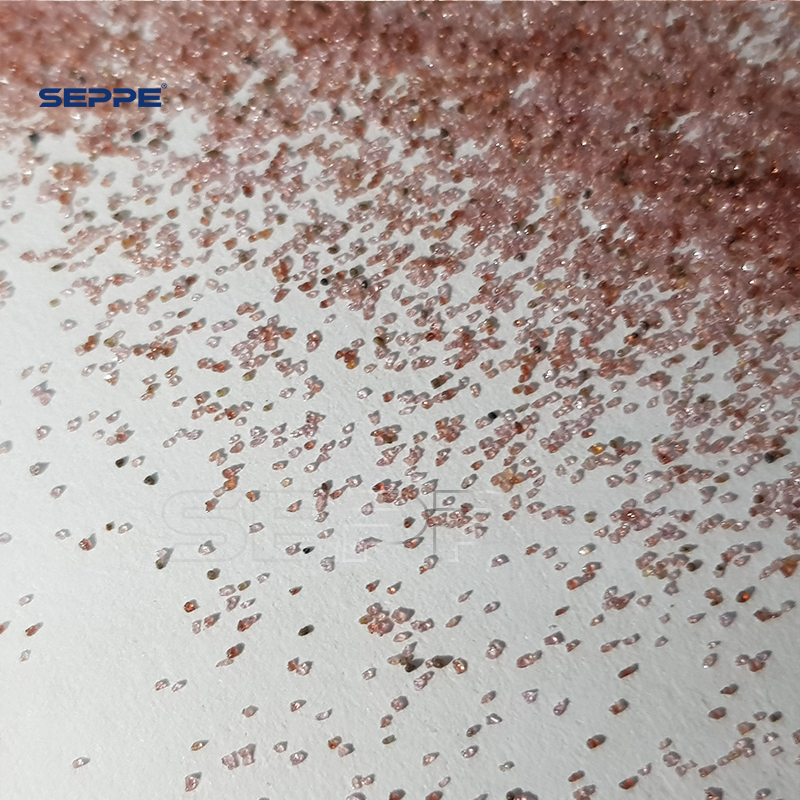
Learn more about 30/60 garnet blasting abrasive.
