
Views: 308 Author: SEPPE Garnet Team Publish Time: 2026-07-29 Origin: SGA Waterjet
Pure waterjets are best suited to softer workpieces. When the material resists the water stream, an abrasive is added. Garnet is the common choice in most abrasive waterjet systems.
Garnet does not enter the high-pressure pump. It joins the water downstream in the mixing chamber, then accelerates through the mixing tube. The water supplies the speed while the garnet grains perform the cutting.
A waterjet abrasive has a demanding job. Each grain must survive acceleration and transfer useful energy at impact. Garnet does this without making mixing-tube wear unnecessarily severe.
The hardest abrasive is not always the most useful. A more aggressive mineral may cut faster at the expense of mixing-tube life. A weak or poorly processed abrasive can break down before it reaches the workpiece.
| Abrasive characteristic | Why it matters |
|---|---|
| Suitable hardness and density | Carry useful cutting energy into hard materials. |
| Controlled particle-size distribution | Supports steady metering and predictable cutting. |
| Limited oversized grains and fines | Helps prevent interrupted flow and avoidable blockages. |
| Clean, dry condition | Reduces clumping and keeps debris out of the feed system. |
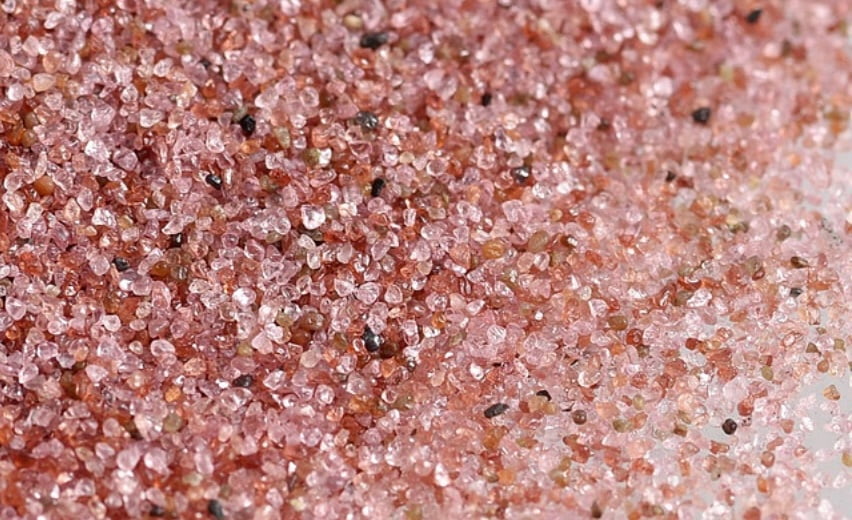
Close-up of alluvial pink garnet abrasive grains.
Alluvial pink garnet can meet these needs, but mineral origin alone does not predict performance. Processing determines what reaches the machine. The important question is whether each batch feeds cleanly and consistently.
For many waterjet systems, 80 mesh is a practical starting point. It often balances cutting rate with edge quality. The cutting-head manufacturer’s specification should still come first.
Finer garnet can suit a more controlled edge. A coarser grade can cut more aggressively, provided the mixing tube supports it. The best choice follows the machine setup and the desired cut, not mesh size alone.
An 80 mesh grade describes a controlled range rather than one identical particle diameter. Products with the same label can still have different distributions. Sieve data shows the difference; a trial cut shows whether it matters on the machine.

Start with the mesh range specified for the cutting head. Protect the abrasive from moisture and make sure the feed system is clean before testing. Then confirm that the actual flow matches the machine setting.
Run a new supply on a familiar job without changing the setup. Watch how steadily it feeds and whether the cut changes. This test says more than the bag price alone.
Need a starting grade? Send us the cutting-head configuration and details of the material through our contact page. We can recommend a practical option for trial cutting.
Standards and independent research
ASTM E11-24 — Woven Wire Test Sieve Cloth and Test Sieves
ISO 3310-1:2016 — Test Sieves of Metal Wire Cloth
ISO 2591-1:1988 — Test Sieving Methods
Boud et al. — Abrasive Waterjet Cutting with 80 Mesh Garnet
Oh et al. — Effect of Garnet Characteristics on Abrasive Waterjet Cutting
